

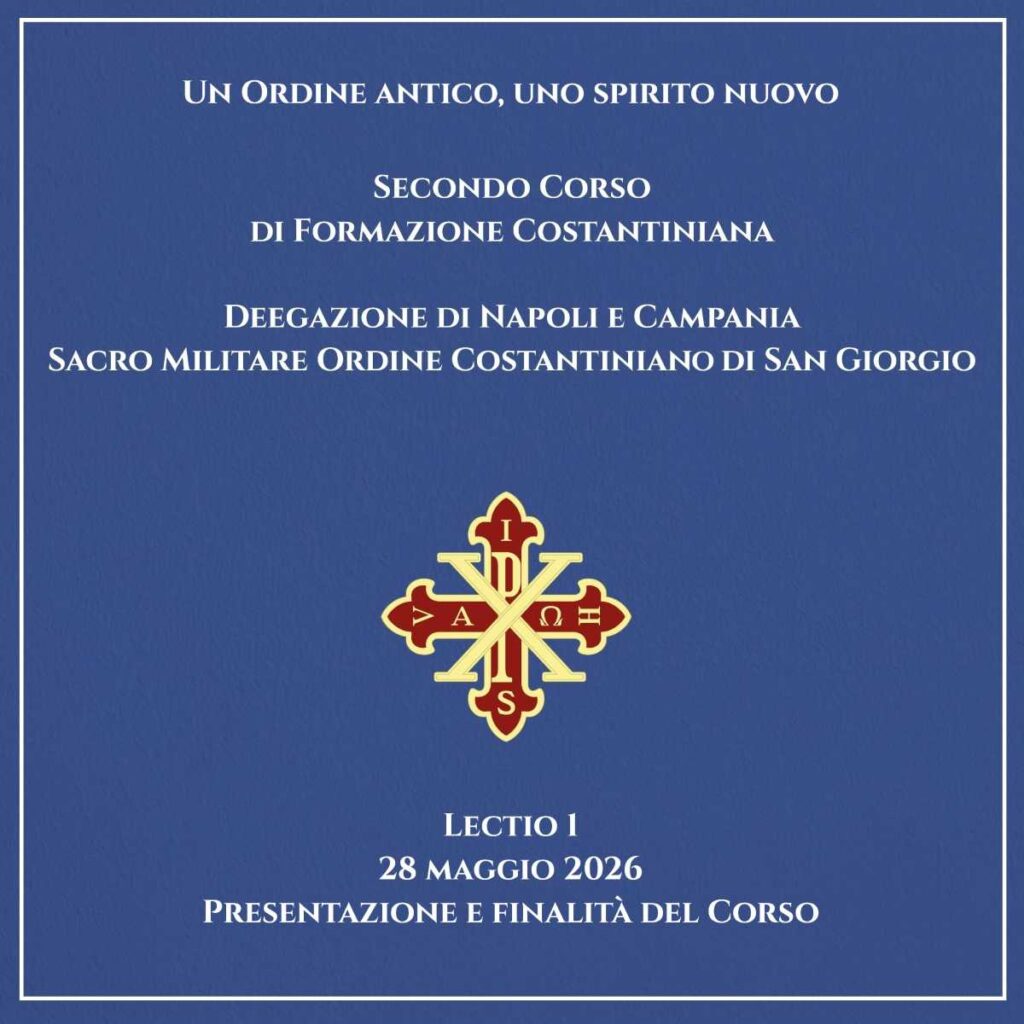
The Naples and Campania Delegation of the Sacred Military Constantinian Order of Saint George has inaugurated its Second Constantinian Formation Course. This path is structured across eleven Thursdays, running from May 28, 2026, to April 15, 2027, and is dedicated to deepening the knowledge of the history, spirituality, and purposes of the Order.
The course is primarily aimed at new Knights, Postulants, and those wishing to approach the Order, offering them the necessary tools to understand and live out their membership:
“Always be ready to give an explanation to anyone who asks you for a reason for your hope, but do it with gentleness and reverence, keeping your conscience clear, so that, when you are maligned, those who defame your good conduct in Christ may themselves be put to shame.” (Cf. 1 Peter 3:15-16).
At the heart of this project is the conviction that training is an essential tool for effectively carrying out the Order’s mission. While rooted in a centuries-old tradition, the Sacred Military Constantinian Order of Saint George intends to respond to the demands of the present day through the constant cultural, spiritual, and operational renewal of its members.
Belonging to the Order is not a mere honorary distinction; it is a calling—a vocation to safeguard the history and tradition of the Constantinian family, and to work for spiritual and social good. The only limits to this work are those of the Knights and Dames themselves, who serve as the true drivers of its fulfillment. This balance is fundamental to doing good in the best possible way: within an ancient Order, using a spirit and tools that are always new, ready to respond to the needs of the times.
In this context, Knights and Dames are called to be active protagonists in the life of the Order, contributing through their commitment to the realization of its institutional goals. This action develops entirely outside of political or partisan logics, finding its foundation in the Catholic faith and the desire to work for the greater glory of God, placing the human being at the center at all levels, with particular attention to those living in fragility and need.
Participation in the Constantinian Formation Course is also recommended for existing Knights and Dames of the Order, as it offers further opportunities to deepen and update their knowledge of Constantinian values, history, and activities.
Dates and Themes of the Lectures (Lectiones)
-
May 28, 2026 – Presentation and Objectives of the Course
-
June 25, 2026 – Religious and Spiritual
-
July 16, 2026 – Historical and Informational
-
September 24, 2026 – Technical and Operational – First Aid
-
October 22, 2026 – Religious and Spiritual
-
November 19, 2026 – Historical and Informational
-
December 17, 2026 – Technical and Operational – First Aid
-
January 21, 2027 – Religious and Spiritual
-
February 25, 2027 – Historical and Informational
-
March 25, 2027 – Technical and Operational – First Aid
-
April 15, 2027 – Conclusion of the Course
The First Meeting: Basilica of San Giovanni Maggiore
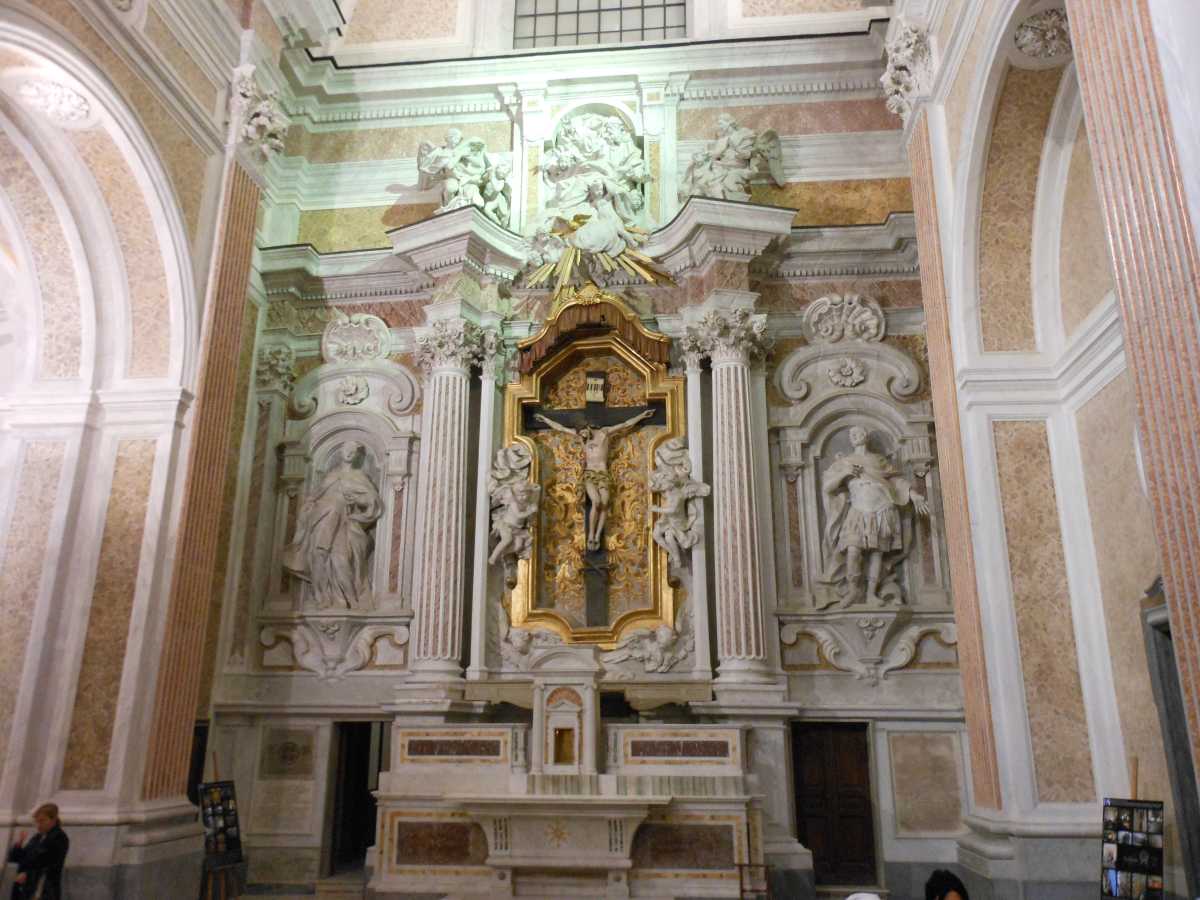
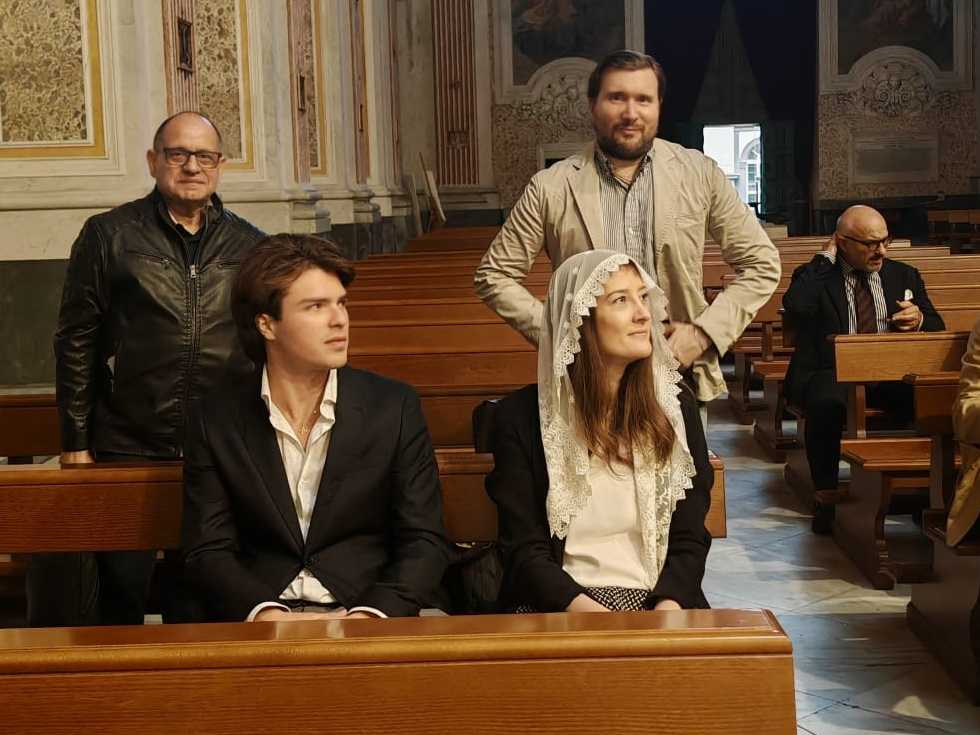
The first educational meeting, dedicated to the presentation and goals of the course, took place on Thursday, May 28, 2026, at 6:00 PM at the Basilica of San Giovanni Maggiore, the seat of the Constantinian Magisterial Chapel in Naples (Rampe San Giovanni Maggiore 1/Piazzetta Orientale, Via Candelora 22), specifically inside the Oratory (or Cappellone) of the Most Holy Crucifix.
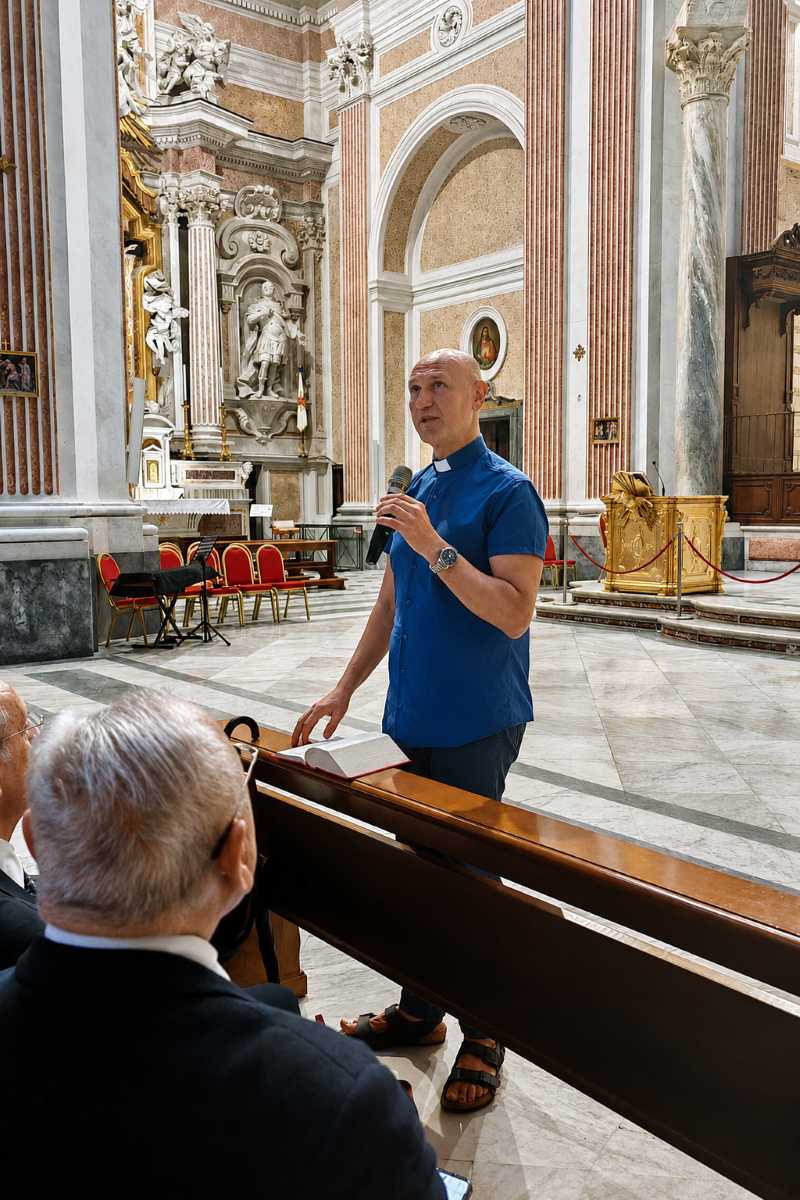
The first meeting was led by the Delegate for Naples and Campania of the Royal Commission for Italy, Count Don Gianluigi Gaetani dell’Aquila d’Aragona of the Dukes of Laurenzana, Neapolitan Patrician, and Knight of Justice, who will also preside over the final meeting of the cycle. Additionally, the Parish Priest of San Giovanni Maggiore, Father Salvatore Giuliano, Chaplain of Merit, delivered an address.
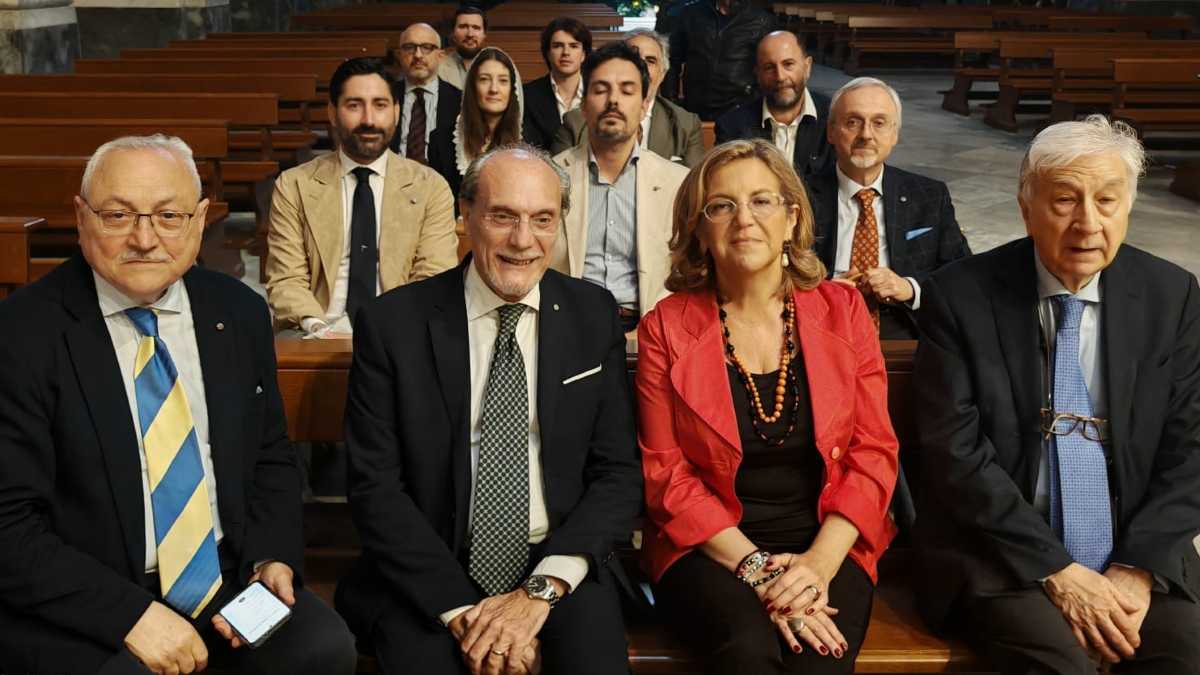
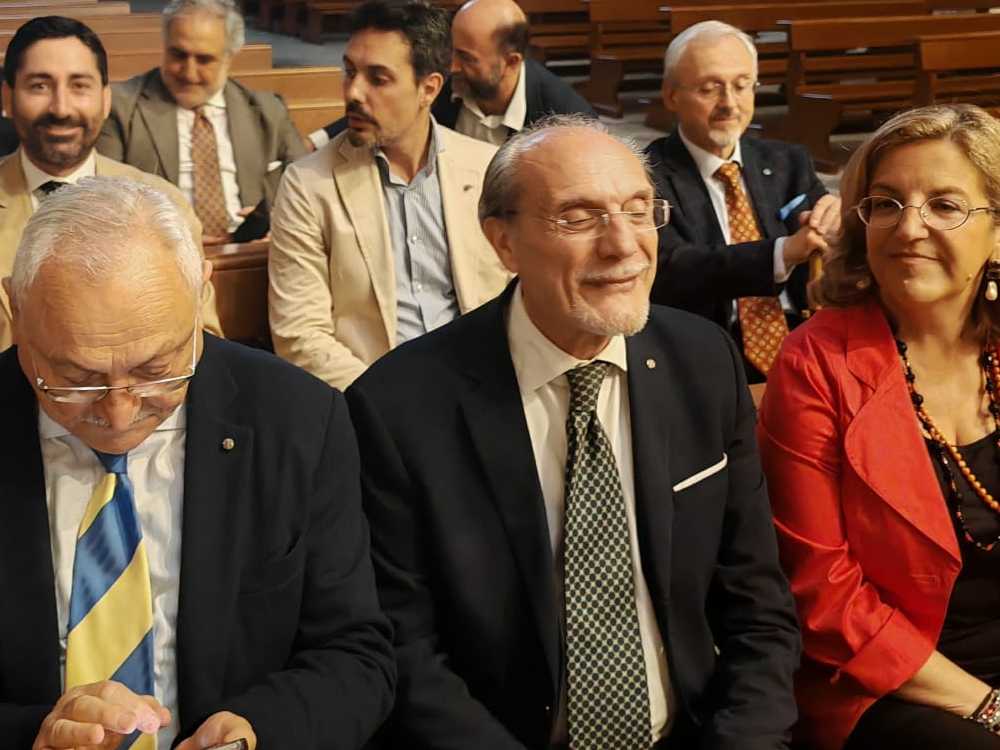
The event was attended by:
-
Nob. Antonio Masselli, Knight of Jure Sanguinis (Interim Secretary General)
-
Prof. Antonio De Stefano, Knight of Jure Sanguinis (Interim Head of Communications)
-
Atty. Valeria Pessetti, Dame of Merit with Silver Star (Interim Head of Operational Activities)
In introducing the theme of the first Lectio, the Delegate highlighted that this educational journey is designed for those who wish to deepen their understanding of the Constantinian Order, its aims, its values, and the activities that characterize its actions. It marks an initial moment of welcome, but also an opportunity to reflect on the path traveled so far, the current reality of the Delegation, and future objectives.
The Delegate then gave the floor to Father Salvatore Giuliano to introduce the educational path, drawing inspiration from the Prologue of the Gospel of John and theosis as man’s participation in the life of God through love, service, and communion. Subsequently, the Delegate spoke again, illustrating the purposes of the Constantinian Order alongside the completed and planned activities of the Delegation.
Address by Father Salvatore Giuliano
Opening his introductory remarks, Father Salvatore Giuliano called attention to the historical and spiritual value of the setting hosting the launch of the Delegation’s new educational path: the Basilica of San Giovanni Maggiore, one of the oldest places of worship in the city of Naples. Having remained closed for about forty years following a ceiling collapse in the 1970s, it was restored to the community thanks to a major historical and archaeological recovery project.
According to tradition, the basilica’s origins date back to the era of Emperor Constantine, who intended to dedicate the site to Saint John the Baptist to thank God for the safe arrival of his daughter, Costanza, in Naples after a particularly difficult sea crossing. From an ancient pagan temple, the complex was thus transformed into an early Christian church. Over the centuries, the building underwent numerous architectural interventions that altered its appearance, though it still preserves important testimonies of its origins—including several columns, arches, and part of the apse—alongside the Baroque elements visible today.
Father Giuliano then launched the second edition of the educational path by reflecting on the Prologue of the Gospel of John, chosen as the guiding text to deepen the meaning of the Christian Faith. He pointed out how Saint John stands out from the other evangelists due to the profoundly theological and spiritual approach with which he presents the figure of Jesus. It is no coincidence that his traditional symbol is the eagle, an image that recalls the capacity to soar toward the contemplation of the divine mystery.
The course aims to accompany participants on a journey of growth and deepening of the Faith received through the sacraments of Christian initiation. Knowledge of the Gospel, Father Giuliano stressed, is not a milestone achieved once and for all, but requires a constant commitment to formation and reflection.
At the core, Father Giuliano positioned the idea of the Gospel as a living word, capable of not only being read but also of questioning and transforming people’s lives. It is a message that retains all its relevance even in the contemporary context, which is marked by profound cultural and social challenges.
Furthermore, Father Giuliano recalled the historical role of chivalric orders, which were born for the defense and witnessing of the Christian Faith. This mission, though taking on different forms compared to the past, continues today to call every believer to the responsibility of knowing, living, and transmitting the Gospel. He dedicated particular attention to the famous passage from the Johannine Prologue: “And the Word became flesh and dwelt among us,” considered the foundation of Christian dignity and divine sonship. From this perspective, Father Giuliano also recalled the Eastern tradition of theosis (divinization), understood as man’s participation in the life of God through love, service, and communion.
Concluding, Father Giuliano recalled the evangelical teaching that true greatness is not measured by the power exercised over others, but by the capacity to serve. With this spirit, the training course begins, presented as an opportunity for spiritual growth, deepening of Faith, and service to the community.
Address by the Delegate
During his address on the purposes of the Constantinian Order and the activities of the Naples and Campania Delegation—encompassing charitable commitment, training, and cultural promotion—the Delegate, Count Don Gianluigi Gaetani dell’Aquila d’Aragona, retraced his own experience since receiving the mandate to lead the Delegation. Upon assessing the status of the Delegation, he designed a highly specific program and an innovative restructuring path centered around training. Thanks also to the help of the Chaplains, this project has transformed into a vehicle for growing engagement and a “living and dynamic” reality in constant dialogue with the Catholic Church.
The Delegate highlighted the construction of a strong and lasting relationship established with the Archdiocese of Naples and its Metropolitan Archbishop, His Eminence Cardinal Domenico Battaglia. This has resulted in a series of joint activities, the assignment of several Chaplains, and a headquarters within the Basilica of San Giovanni Maggiore, selected as a symbolic and historical anchor for the path undertaken. This process, as the Delegate illustrated, fits into a broader blueprint for development.
At the heart of his address, the Delegate focused on defining chivalric identity, interpreted not as a formal or anachronistic element, but as a lifestyle founded on Faith, education, kindness, and service toward the most fragile, in continuity with the historical tradition of the Knight committed to protecting the weak.
On an operational level, the Delegate illustrated the charitable activities launched in collaboration with the Archdiocese of Naples, with particular reference to supporting the “Don Tonino Bello” House of Peace (Casa della Pace). This is done through the supply of basic necessities, medicines, food, blankets, and cookware, alongside specialized medical-sanitary assistance and prioritized care pathways that have benefited mothers suffering from various pathologies or traumas. The House of Peace, he noted, is a shelter that welcomes mothers in difficulty, immigrants, single mothers, or war refugees with histories of deep suffering. During his meeting in Naples, the Holy Father, Pope Leo XIV, pointed to the House of Peace as an exemplary and important work carried out in the City of Naples. All members of the Delegation are actively involved in these dedicated service actions.
Alongside aid efforts, the Delegate emphasized the cultural and project-based dimensions of the Delegation, featuring initiatives for the study and preservation of the Constantinian Order’s historical archives and the organization of musical and concert events, funded in part by resources made available by the Knights and Dames themselves. Among these, he recalled:
-
The charity concert held at San Giovanni Maggiore last December to support 80 families in difficulty who are assisted by the parish and “adopted” by the Delegation.
-
The St. George Pontifical Mass at Santa Chiara, featuring a full 27-piece orchestra and choir, held in the presence of His Royal Highness the Grand Master.
The Delegate hinted at new initiatives planned across Campania, including projects to recover unedited historical musical repertoires. He clarified that reclaiming this history is not aimed at any political activity, but is oriented purely toward cultural and scientific pursuits for the rediscovery and critical re-reading of historical sources.
Ample space was dedicated to the Delegation’s training program, which is divided into eleven monthly meetings. These include historical and spiritual studies, alongside major liturgical celebrations such as the Exaltation of the Holy Cross, the Pontifical Mass of Saint George, and Marian feasts linked to the tradition of the Immaculate Conception.
In his speech, the Delegate also recalled the figure of the Servant of God Francis II of Bourbon, King of the Two Sicilies, whose beatification process is currently in its diocesan phase. He highlighted the king’s historical complexity, his deep bond, and his coherent attitude toward his Catholic Faith even during the most difficult moments of his reign and life. This reflection was integrated into the Delegation’s broader project aimed at expanding activities across the entire territory of Campania. This regional expansion plan, carried out in collaboration with local Dioceses and ecclesial realities, also envisions involving young people through training and practical activities, including basic elements of first aid and emergency management.
The Delegate emphasized the concrete value of belonging to the Constantinian Order, noting it cannot be reduced to a symbolic aspect but is an expression of personal and spiritual responsibility. In this perspective, he pointed to the church mantle (the mantle worn during liturgies) as a sign of this belonging and commitment.
The Delegation’s charitable activities will remain a central pillar, with initiatives to support families in need, particularly during major holidays, through the distribution of food packages and targeted contributions.
In conclusion, the Delegate reaffirmed the objective of building a stable network across the Campania region, in synergy with the Dioceses and local Diocesan Caritas organizations, capable of uniting spiritual, cultural, and operational dimensions across the provinces of Avellino, Benevento, Caserta, Naples, and Salerno.
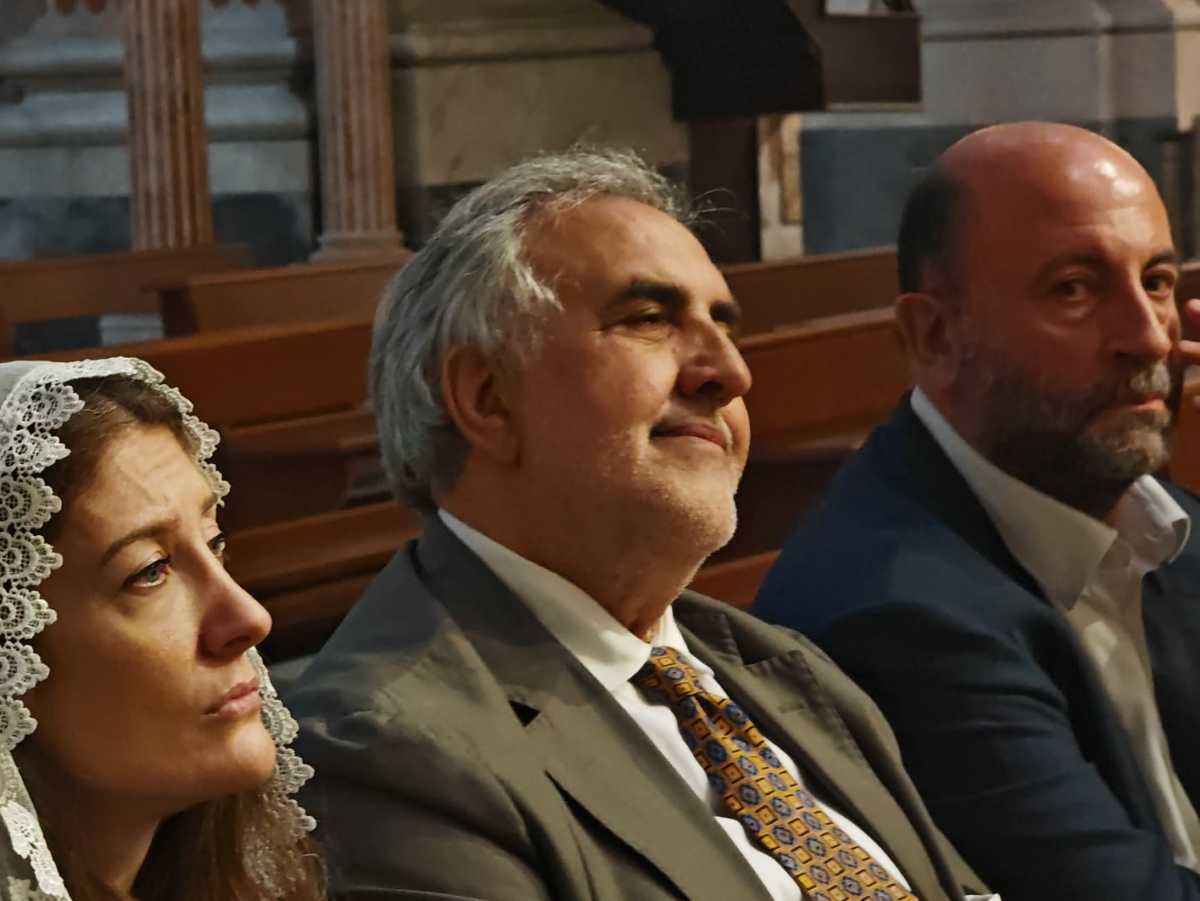
Following the Delegate’s address, an exchange of comments and discussion took place among the attendees.

Intervento del Delegato
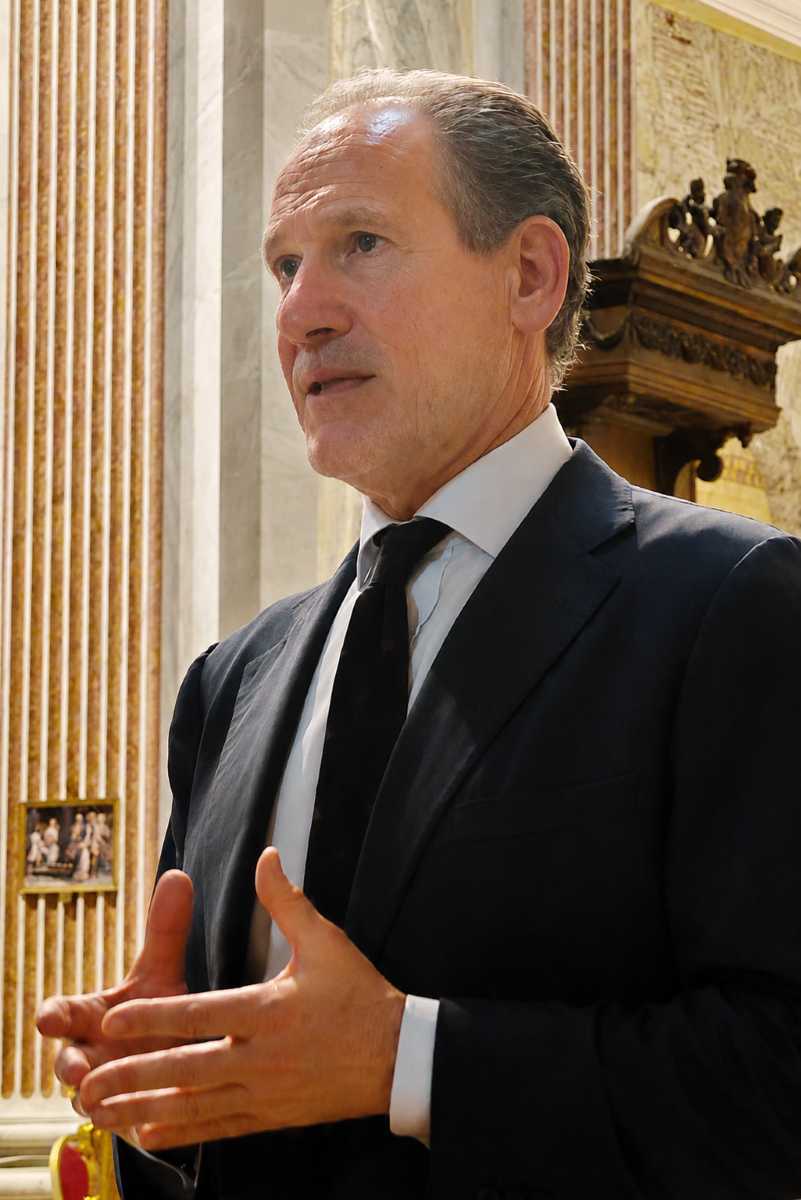
PHOTOGRAPH AT TOP: The Delegate for Naples and Campania of the Royal Commission for Italy, His Excellency Count Don Gianluigi Gaetani dell’Aquila d’Aragona of the Dukes of Laurenzana, Neapolitan Patrician, and Constantinian Knight of Justice


