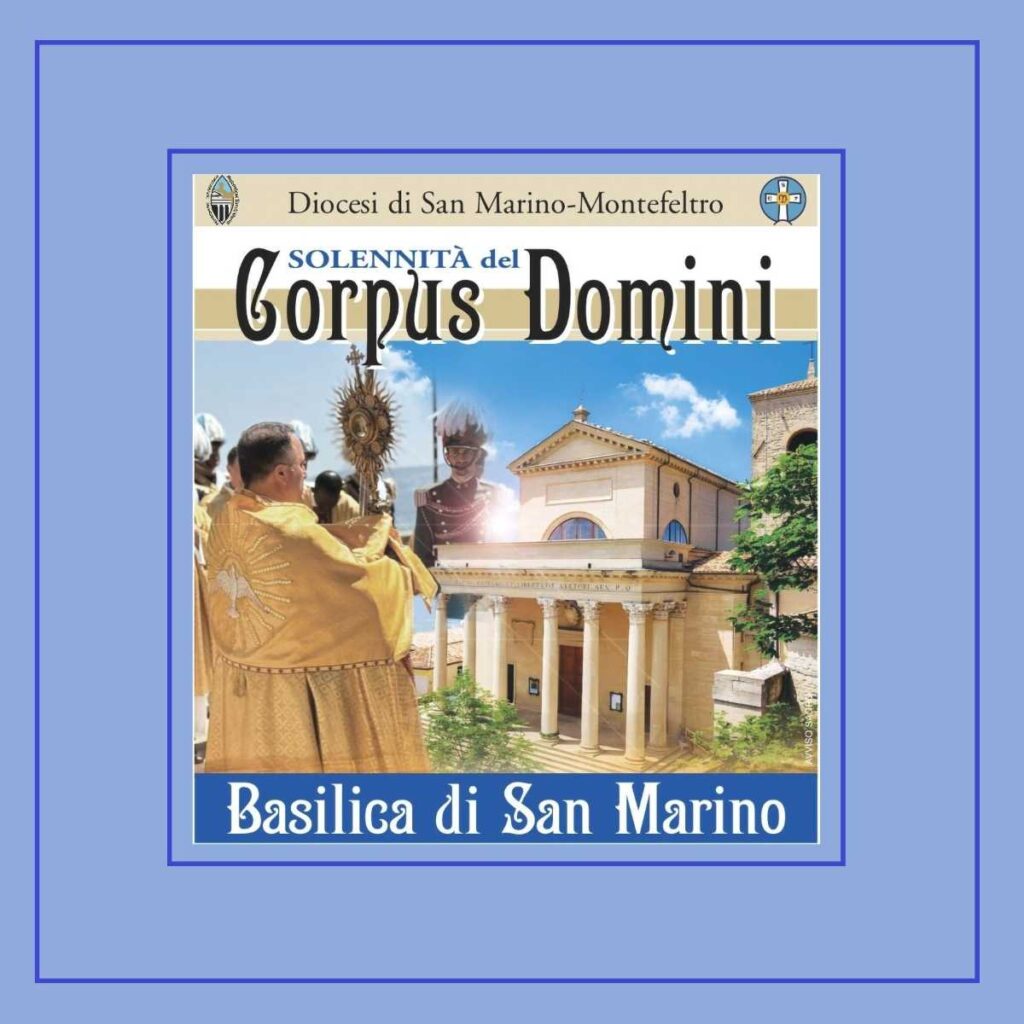
On Thursday, 4 June 2026, the Solemnity of the Most Holy Body and Blood of Christ, at 10:00 a.m. in the Basilica del Santo in Piazzale Domus Plebis, within the walls of the ancient city of the Republic of San Marino, the celebration of Corpus Christi took place, a national holiday of the Most Serene Republic of San Marino. The Basilica del Santo, the Republic’s principal church, stands upon the foundations of the medieval parish church and houses the relics of Saint Marinus, founder of the community in the fourth century.
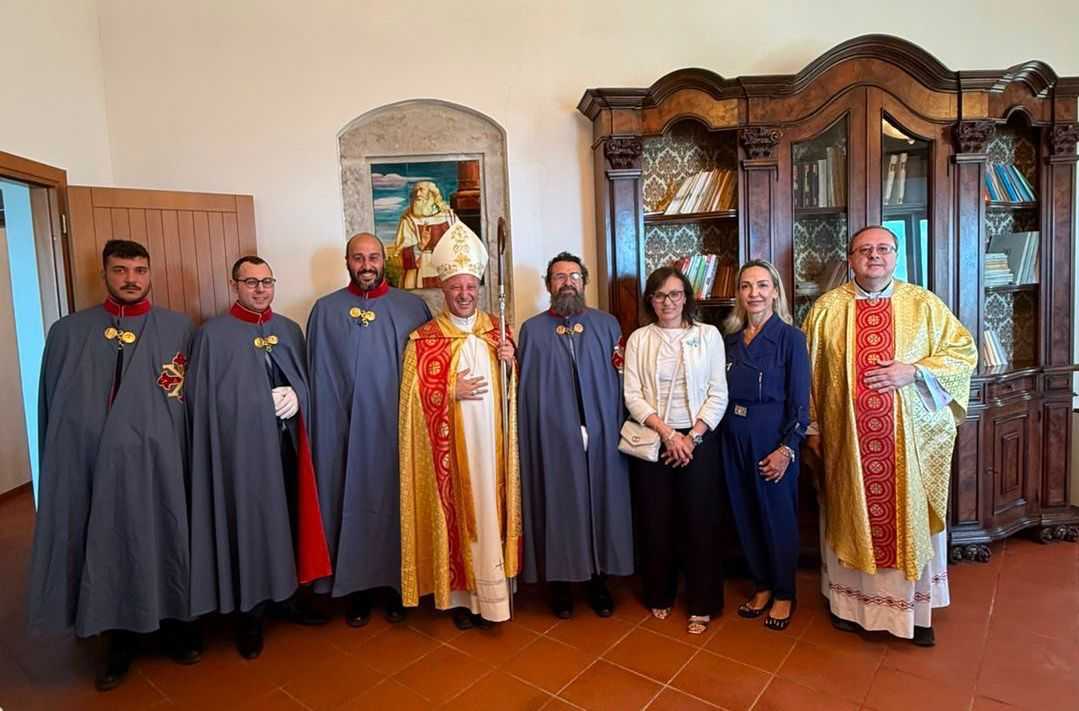
As previously announced, the Delegation of the Royal Commission for the Most Serene Republic of San Marino of the Sacred Military Constantinian Order of Saint George took part for the first time since its establishment in the Holy Mass of Corpus Christi and the subsequent Eucharistic Procession through the historic centre. The delegation was led by its Delegate, Dr Cesare Tabarrini, Knight Grand Cross of Merit and member of the Royal Commission. The Knights wore the Order’s church mantle, the Dames wore dark attire with their miniature decoration, and the postulants were dressed in dark formal attire.
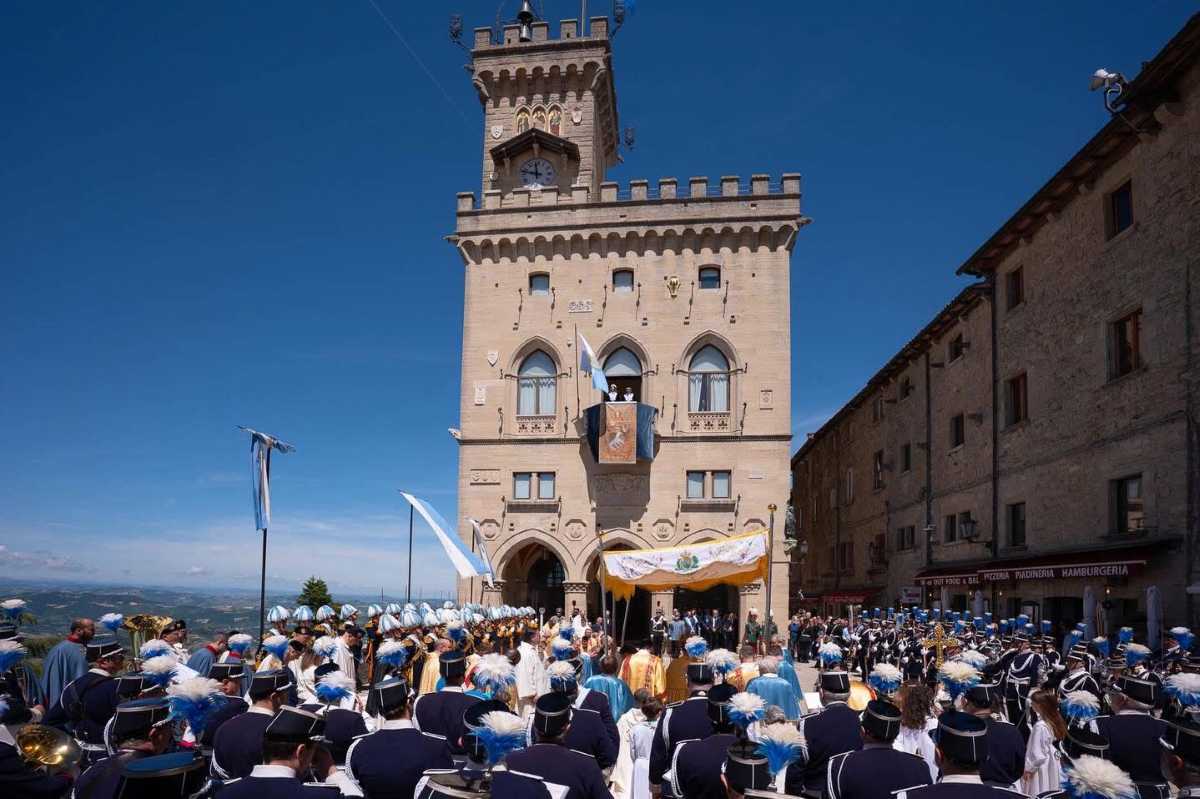
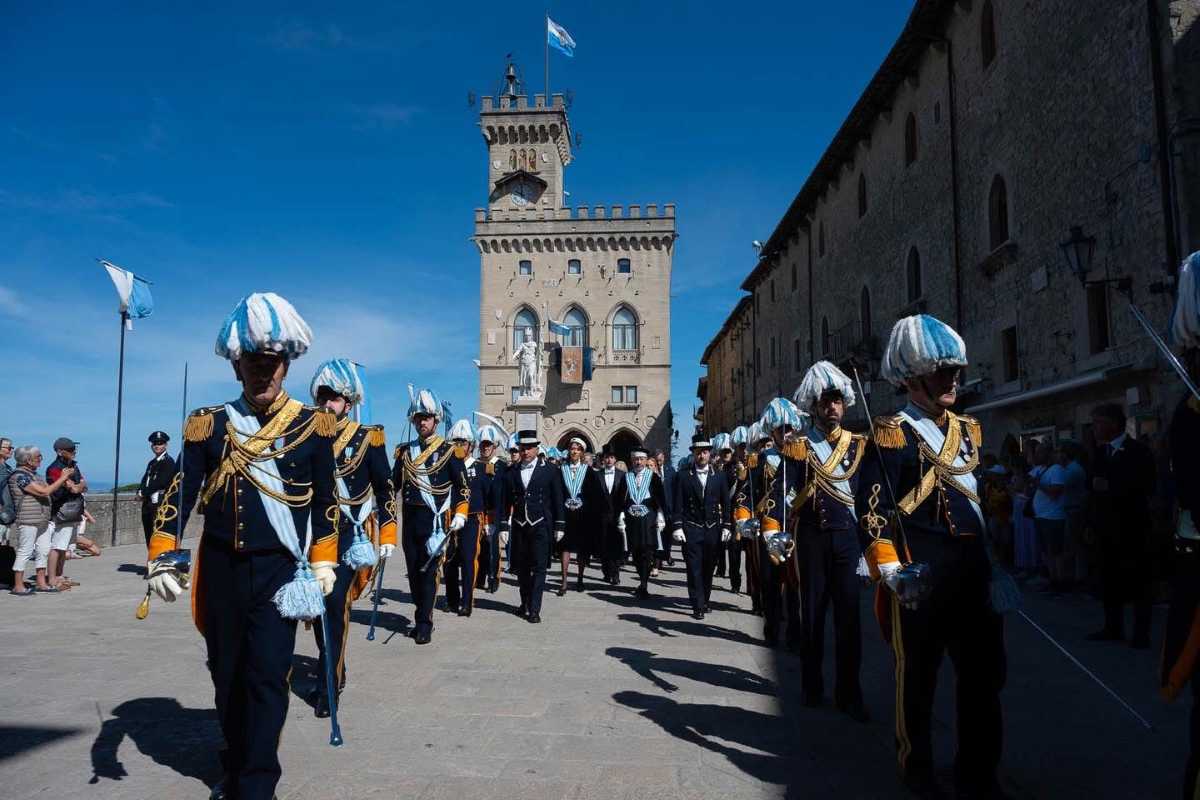
According to a ceremonial tradition that has remained virtually unchanged over time, the morning of Corpus Christi in the Republic began in Piazza della Libertà with the formation of the Guard of the Great and General Council, the military corps, and the Military Band, which performed the national anthem during the flag-raising ceremony.
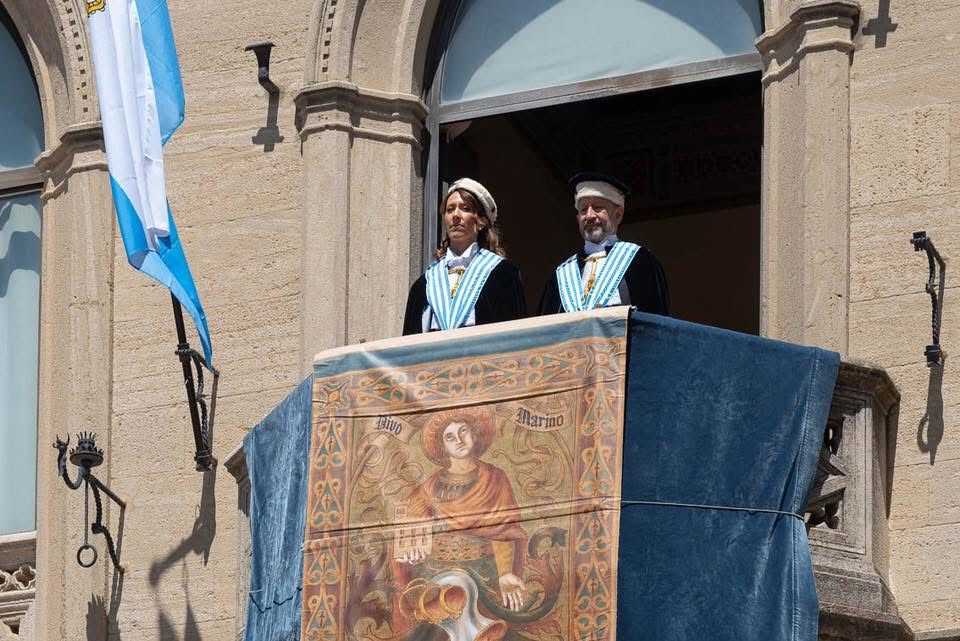
The Solemnity of Corpus Christi, which falls on the sixtieth day after Easter, is generally celebrated in Italy and several other European countries of Catholic tradition on the following Sunday. In San Marino, however—as also in Austria, Poland, Portugal, and several Italian dioceses—it continues to be observed on its canonical day, reflecting its status as a feast of primary importance. On this occasion, the Captains Regent wear the traditional ceremonial dress and the Grand Collar of the Order of San Marino, as they do only during the most solemn state ceremonies.
Shortly before 10:00 a.m., the official procession, led by Their Excellencies the Captains Regent Alice Mina and Vladimiro Selva, together with representatives of the Congress of State, the Captains of Castle, civil and military authorities, and the Ambassador of Italy, H.E. Fabrizio Colaceci, proceeded to the Basilica for the celebration of Holy Mass.
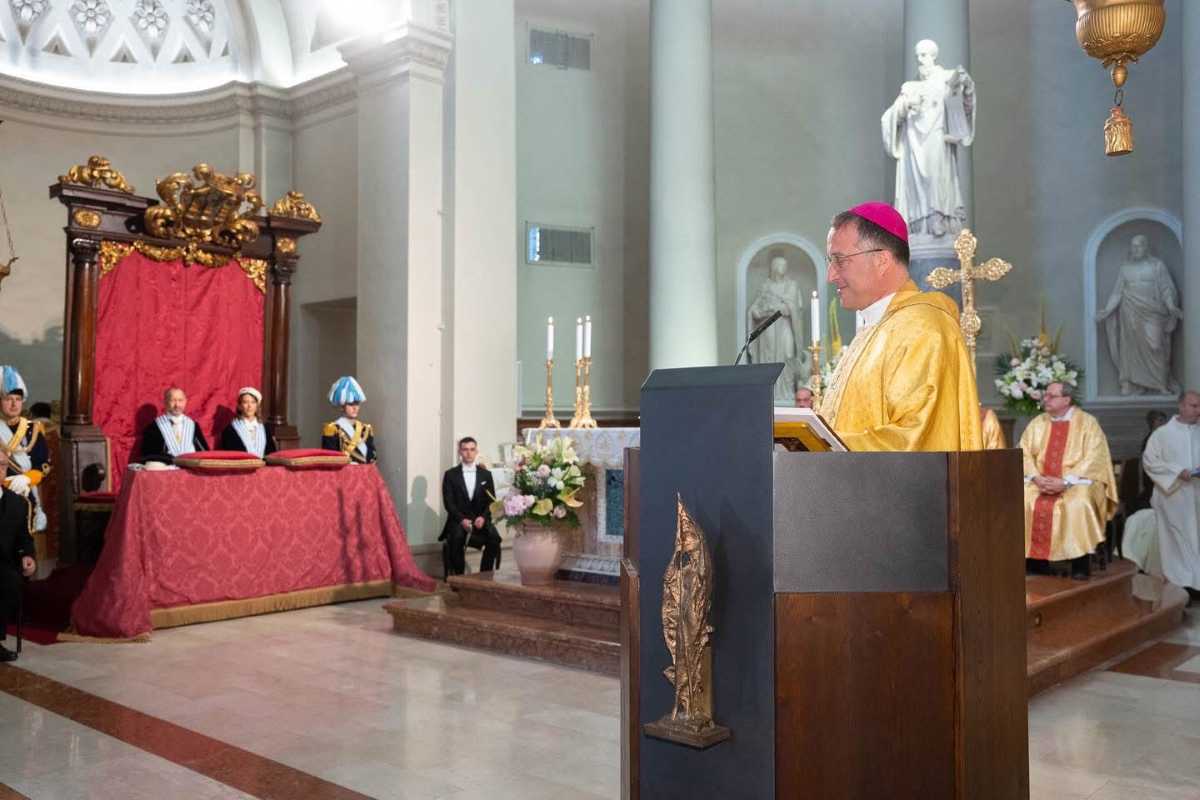
They were welcomed at the entrance by the Rector of the Basilica del Santo, Fr Marco Mazzanti. The Eucharistic Celebration was presided over by the Bishop of San Marino-Montefeltro, H.E. the Most Rev. Domenico Beneventi.
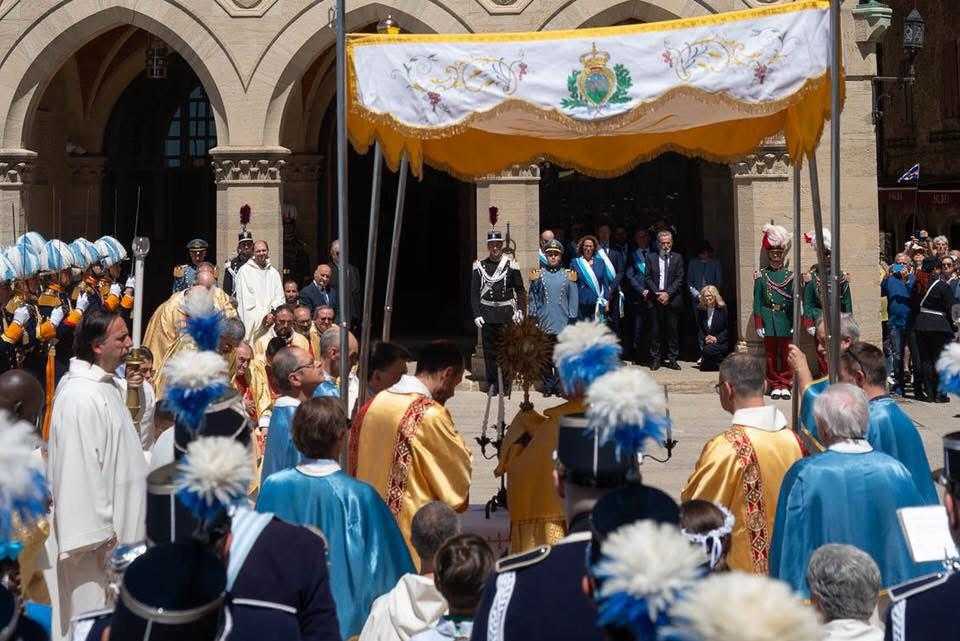
At the conclusion of the Sacred Liturgy, the Captains Regent and the official procession returned to the Public Palace. Shortly thereafter, following its route through the streets of the historic centre, the Eucharistic Procession carrying the Blessed Sacrament arrived in Piazza della Libertà. From the balcony of the Public Palace, the Regency attended the Eucharistic Benediction, the final act of the celebrations before the lowering of the flag.
The Feast of Corpus Christi in the Republic of San Marino is both a religious and a civil holiday. In Italy, by contrast, the feast ceased to be a public holiday in 1977 and is now generally celebrated liturgically on the following Sunday, while schools and offices remain open on the Thursday on which the sixtieth day after Easter falls. Instituted by the Church in the thirteenth century, the solemnity celebrates the Real Presence of Jesus Christ in the Sacrament of the Eucharist. Unlike the more austere atmosphere of Holy Thursday, Corpus Christi is marked by joyful public celebrations, with solemn Masses and Eucharistic processions taking place in parishes throughout Italy. In Rome, the principal celebrations centre around the Mass celebrated by the Cardinal Vicar at the Basilica of Saint John Lateran, while in Campobasso the traditional civic festivities are accompanied by fairs and attractions in the Selva Piana district.
The origins of the feast are linked to two events: the mystical visions of Saint Juliana of Cornillon, a Belgian nun in the early thirteenth century, and the Eucharistic Miracle of Bolsena, which occurred in the summer of 1263. According to tradition, the miracle involved Peter of Prague, a Bohemian priest troubled by doubts concerning the Real Presence of Christ in the consecrated Host. During the celebration of Mass in Bolsena, the corporal was said to have become stained with blood.
The following year, on 11 August 1264, Pope Urban IV promulgated the bull Transiturus de hoc mundo, extending the feast to the entire universal Church and entrusting Saint Thomas Aquinas with the composition of its liturgical texts. The bloodstained corporal is today preserved in the Cathedral of Orvieto, built specifically to house the relic, while the marble stones associated with the miracle are venerated in the Basilica of Saint Christina in Bolsena.
In addition to Corpus Christi, 2 November, the Commemoration of All the Faithful Departed, is also a national holiday in the Most Serene Republic of San Marino, unlike in Italy, where it ceased to be a public holiday under Law No. 54 of 1977. Enacted during a period of economic austerity with the aim of increasing productivity, the law also abolished several other public holidays, including Epiphany (later restored in 1986), Saint Joseph’s Day, Ascension Thursday, and the Solemnity of Saints Peter and Paul. San Marino partially aligned its calendar in 1990 through Law No. 152, which removed public holiday status from Saint Joseph’s Day, Ascension Thursday, Saints Peter and Paul, the afternoon of the final day of Carnival, 14 August, 16 August, 24 December, and 31 December.