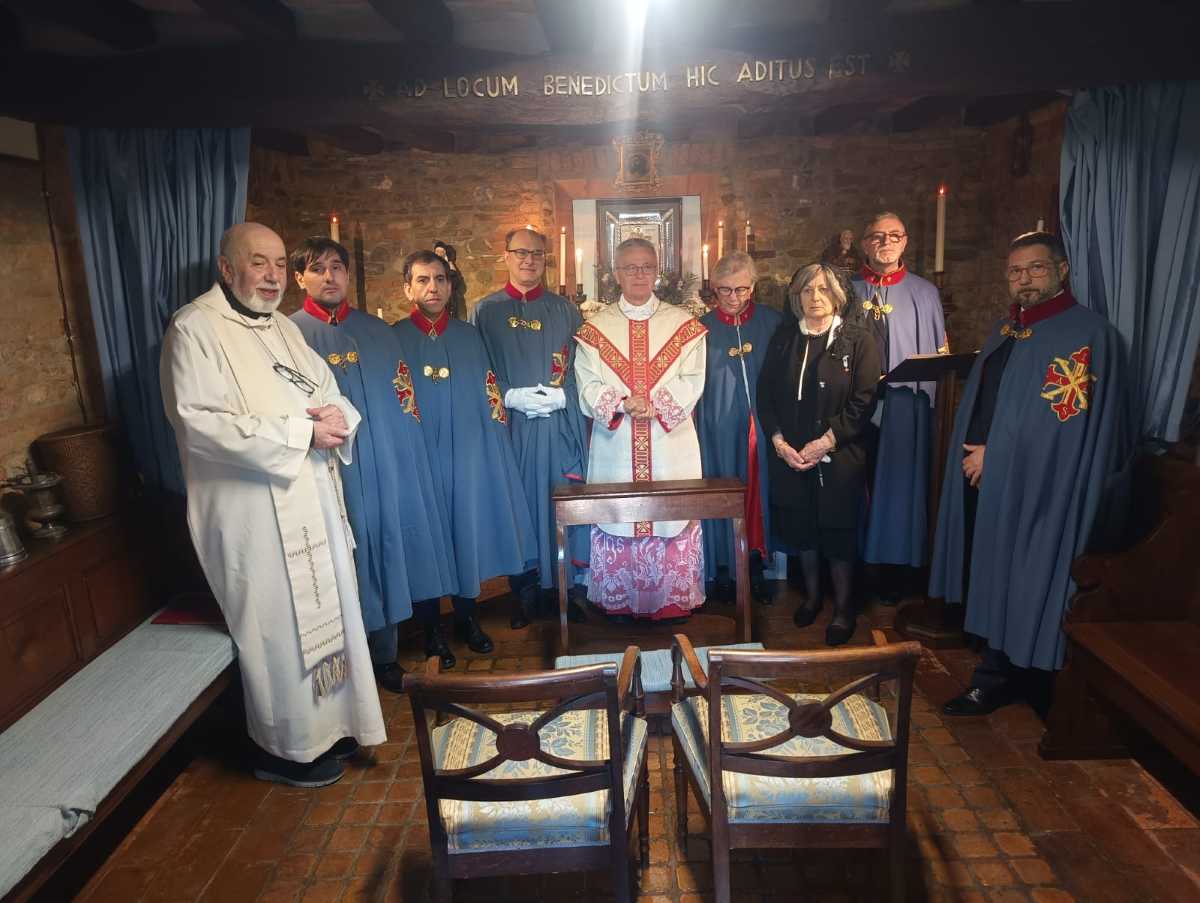
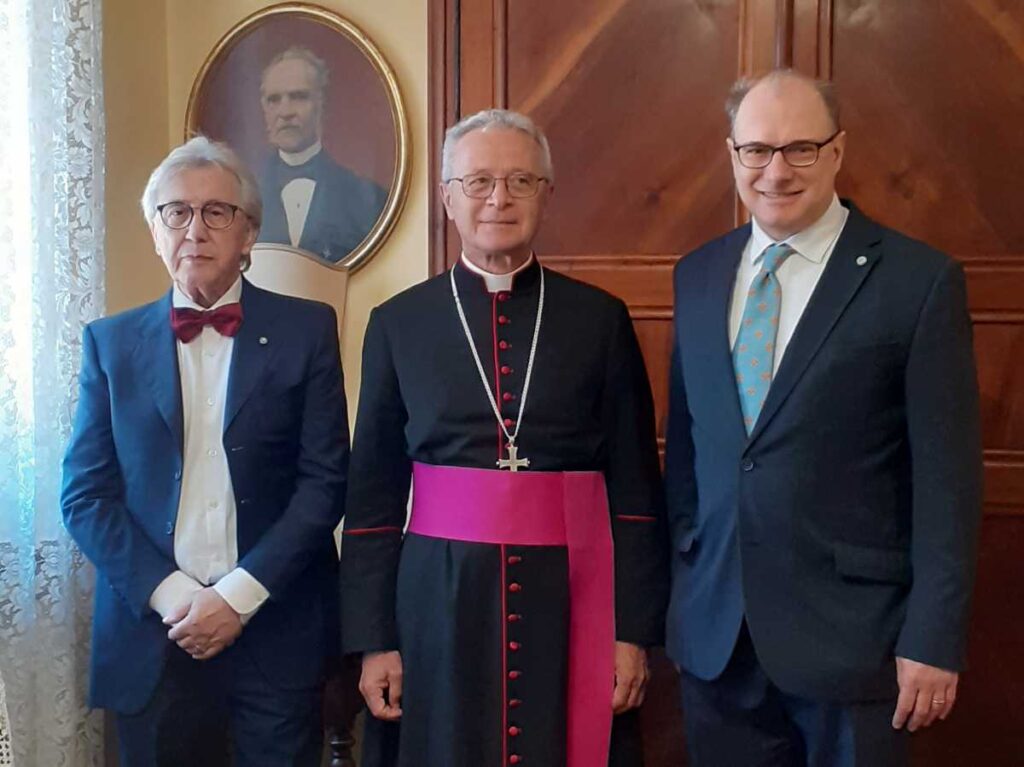
On Saturday, May 2, 2026, the Emilia Section of the Triveneto and Emilia Delegation of the Sacred Military Constantinian Order of Saint George, led by the Representative for Emilia, Avv. Giacomo Fontana, Knight of Merit, gathered in Castelnuovo Rangone to honor Saint George, Patron of the Constantinian Order. At 11:00 a.m., in the private chapel of Villa Romani at Piazza Borgo di Sotto 2, the Most Reverend Francesco Cavina, Bishop Emeritus of Carpi, presided over the celebration of Holy Mass, concelebrated by Father Luciano Benassi.
At the conclusion of the Mass, the participants were received in the hall by the family of Dr. Cesare Romani, Knight of Merit with Silver Star. Afterwards, they proceeded to the local Golf Club for a confraternal luncheon gathering.
The territory of Castelnuovo Rangone, located approximately 12 kilometers from Modena, has very ancient origins, with traces of settlements dating back to the Bronze Age, particularly in the hamlet of Montale. The first written mention of the town dates to 1025 and, throughout the Middle Ages, the area was long contested among various local families until it was granted in fief in 1391 to the House of Rangoni, which governed it until 1796. Under their rule, Castelnuovo experienced economic and cultural development and also became a place of residence for the poet Torquato Tasso.
With the end of feudalism and the reestablishment of the municipality in 1860, the area began a process of transformation accompanied by progressive urban growth. Among the notable local landmarks is Villa Romani, formerly known as Borgo di Sotto, documented since the fifteenth century as a fortified rural residence integrated into the agricultural system of the territory.
In 1532, the structure was donated to a charitable institution in Modena and later passed through various owners, while maintaining its agricultural and residential functions. In the twentieth century, the Romani family promoted its restoration, giving it its present appearance.
The surrounding territory preserves numerous historical testimonies: in Montale lies the tomb of the tenor Luciano Pavarotti, while nearby centers such as Castelvetro and Levizzano still retain evident traces of their medieval origins and the local feudal system.
In his homily, Bishop Francesco Cavina recalled the figure of Saint Athanasius — whose liturgical memorial falls on May 2 — and his inseparable connection with Emperor Constantine the Great, from whom, according to an ancient tradition, the Sacred Military Constantinian Order of Saint George derives its origin. Legend recounts that, on the night before the Battle of the Milvian Bridge against Maxentius, the Christian symbol of the Chi-Rho appeared to the Emperor together with the inscription In Hoc Signo Vinces (“Under this sign you shall conquer”) on October 28, 312.
Bishop. Cavina particularly emphasized the importance and contemporary relevance of the teaching of Saint Athanasius, Bishop of Alexandria in Egypt, Doctor of the Church, and author of the formulation of the Nicene Creed promulgated by the first ecumenical council of 325, convened and presided over by Constantine in order to combat the Arian heresy. The text affirms that the Son is “begotten, not made” and “of one substance” with the Father; it focuses on the Most Holy Trinity, particularly on the consubstantiality of the Son, true man and true God. Arianism, on the other hand, recognized only the human nature of Christ, denying His divine nature, which instead represents the very foundation of Faith, Easter, and Salvation, Bishop Cavina concluded.
At the conclusion of the Mass, the Romani family welcomed the participants into the villa’s hall for an aperitif, presenting each guest with a small bottle of balsamic vinegar of their own production.
Afterwards, at 1:00 p.m., the participants gathered in the restaurant of the local Golf Club for a convivial meal intended to strengthen fraternal bonds, friendship, and solidarity. The luncheon began with a prayer led by Bishop Francesco Cavina and a greeting from the Representative for Emilia. Before taking their leave, the participants enjoyed a walk through the Golf Club park.